
Redesigning Higher Education
What if we designed financial aid around "Community College First"?

I had a conversation recently with John Elrick about his experience going to community college first, and he got me thinking about how we run higher education in America.
Let’s look at what we have right now: some senior high school student does well in school and then spends a few minutes thinking about where they want to go and what school they want to enter, they’re given a financial aid package (usually guaranteed by your tax dollars), and off they go.
Now, IMHO most 17- and 18-year-olds are completely unprepared for making a decision of this magnitude. A lot of what goes into that decision is “Is the school prestegious,“ “Where do I want to live?” and “How much money will I get for scholarships and aid?” They aren’t really thinking about the big picture, like where they will get a job when they finally graduate, what they should major in, and whether going to a “prestigious” college will increase their opportunity for success in a particular field. Most are just happy to leave the house.
I understand it. I was one of those kids. I went for a year at my home campus at the University of Nevada, Reno, and then I went off on a National Student Exchange program to Bowling Green State University. Both of my decisions were based on the low budget my middle-class family could afford. When I decided I wanted to stay at Bowling Green State University, it required a lot more financial planning. I had to take out loans, for example. A lot of loans (in 1980s money—I know, I know! I’m old!!).
However, by the time I needed to find out how to finance my education, I was already a junior and I only had two years to go. So, my loans were pretty small in comparison to those of my fellow students. Also, education was a lot cheaper then. I’ll admit it. By the time I graduated with a Ph.D., my debt stood at $32K. Still, it took me more than 30 years to pay it off—and it got bigger every year.
Now, a a four-year college education is like financing a new car. Graduates leave with thousands of dollars in debt and sometimes very little to show for it. According to the Education Data Initiative, the average student borrows over $30,000 to pursue a bachelor’s degree. This debt usually takes up to 20 years to pay off. Meanwhile, the outstanding loans owed to the US government stand at ~$1.7 trillion. Fewer than 40% of student loan borrowers are in repayment, while about 25% of student loan borrowers are currently in default.
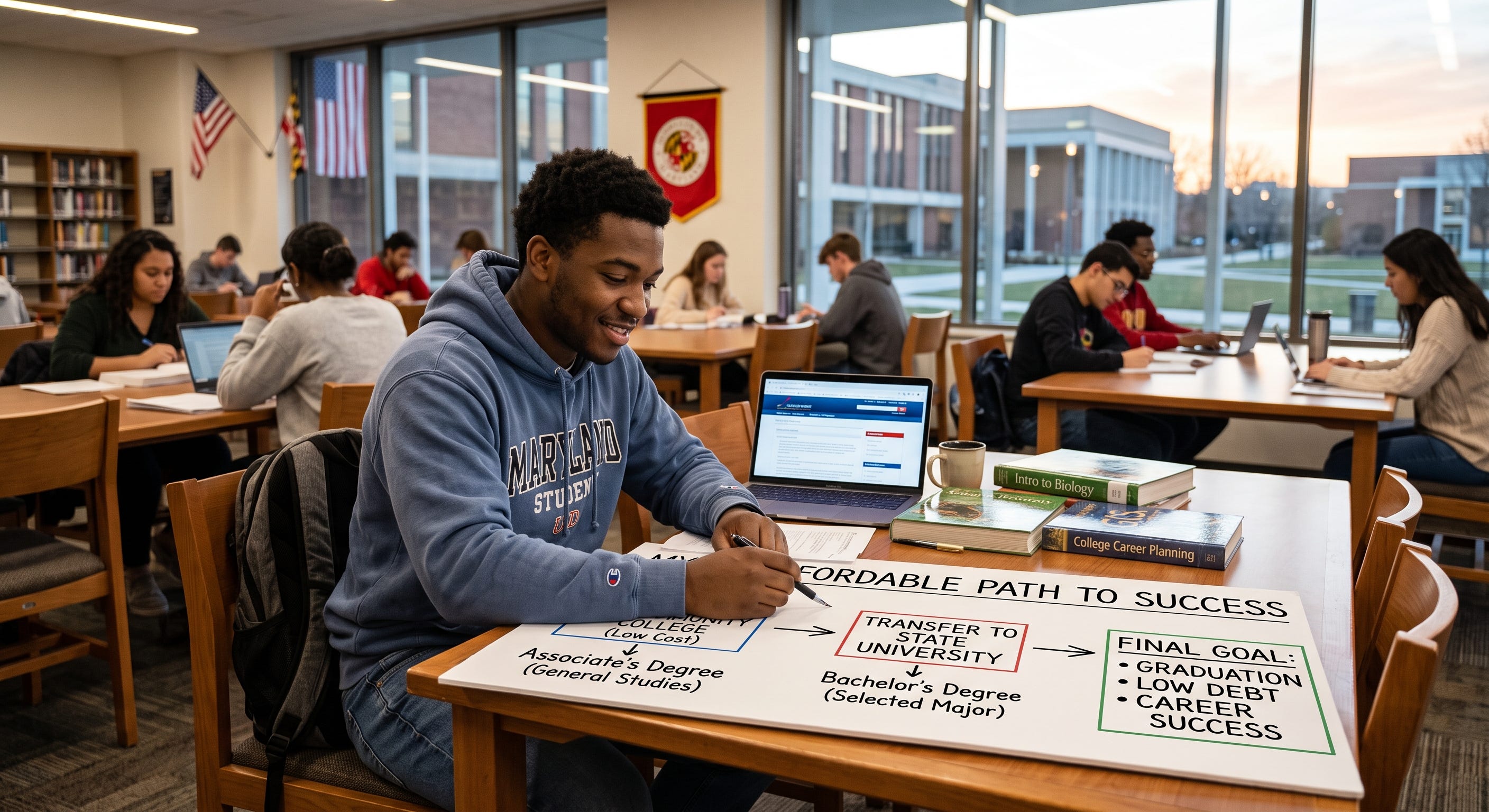
Everyone is complaining about college costs, so here’s my (probably not original) plan: require that students who want financial aid go to a Community College and earn an associate’s degree before attending a baccalaureate program. This would ensure a better educational outcome and save an incredible amount of money for both the student and the US taxpayer.
Let’s look at the advantages of a community college first strategy, shall we?
Focus on achievement. We currently require students to get through elementary school before we allow them in middle school. We require that they get through middle school before they go into high school. At every stage, we make sure our students have achieved something before moving on. Shouldn’t we require an associate’s degree before attending a baccalaureate program? The college progression should look like this: HS Diploma —> Associates Diploma —> Undergraduate Diploma —> Master’s Degree —> Ph.D.
Teaching is Tops at Community Colleges. The first two years of college are essential for setting up the next two. Community Colleges are focused on teaching, universities are focused on research. In a four-year program, freshmen and sophomores are likely to encounter graduate students teaching in large lecture halls. In Community College, freshmen and sophomores are taught in a classroom with a full Ph.D. Let’s put the students where they have the best chance of building their skills—at the schools focused on teaching. Students entering a four-year program with an associate’s degree in hand achieved a 76.3% bachelor’s completion rate within six years.
Drop outs. An average of ~22% of full time first year college students will drop out in the first year of college. That means that almost 1/4 of all college students accumulate debt for that first year with no return on investment. A lot of those students are funded by you and me through our tax dollars. That’s a lot of money. Let’s make sure they really want to go to college and they are good at it before we let them take on the financial obligation required of a university degree.
Remedial education. Right now four-year colleges are having to invest in teaching remedial classes in English and Math. According to the Center for American Progress, “research shows that anywhere from 40 percent to 60 percent of first-year college students require remediation in English, math, or both. Remedial classes increase students’ time to degree attainment and decrease their likelihood of completion.” With a “Community College First” plan, students requiring remedial education would receive that education at the community college level, saving up to $1.3 billion per year.
Most AI-Focused jobs will require content knowledge, but not full mastery. I teach in a Community College with AI every day, and I know that most of the jobs that our graduates will be heading for will require some content knowledge, but not a full mastery of a topic. AI can provide the research juice to learn on the job, and students who have achieved an associates degree will have the foundational research and knowledge base to build on what AI provides. We have a whole new level of knowledge access, and it won’t require a baccalaureate to address it.
The demographic cliff. In 2007, we had a huge recession and the birth-rate dropped off. It hasn’t recovered. That was 18-years ago, and there will be fewer 18-year olds and those 18-year olds will be more critical of whether or not they need college. Gen-Z students are critical of the value of college and whether college skills equal work skills. Community College can give them the education they want at a lower cost and connect them to workforce-ready skills. Community college be the entry point that four-year colleges will need to encourage Gen-Z to pursue higher degrees.
I’m not saying that four-year institutions don’t have advantages for students, but not every student needs to get a four-year degree—especially as AI makes information access and training easier and cheaper. Community colleges are the practical side of higher education, they are workforce focused, and they are very inexpensive.
If we want to make this plan even sweeter, lets provide those first two years gratis—free community college—if students have the grades. Then, when a student reaches the associates degree, financial aid continues into a baccalaureate, and so on. Students who continue on will be much more likely to be successful, they won’t be overwhelmed with debt, and by the time they get through their associates degrees they will have a much better idea of what field they want to pursue, what college they want to attend, and which baccalaureate degree will open the doors to them.
Worried we won’t have enough community colleges for this plan? I’m sure that many of the universities who see a drop in first-year students will scramble to create their own signature two-year associates programs—at a much lower cost. This is a win-win for students, colleges, and the American taxpayer.
Happy Fourth of July!!
Love the idea of public PK-16 for every student! I do hesitate at restricting student pathways through prescribed matricultation. In my 25 years of higher ed experience the majority of students do not engage in a linear education or career pathway. This means that as the world of work evolves around things like AI, students will need to adopt a mindset of lifelong upskilling. This dictates that funding resources should be more flexible and include short-term programs, professional certifications, and other types of postsecondary ed that we classify as "non-credit" or "non-traditional" within current funding and degree granting systems. That doesn't mean we throw away accreditation or other methods that ensure quality of the types of education offered, but it does require a larger culture shift that will consider how we currently use traditional Title IV financial aid which dictates things like merit, maximum timeframes, and limits the types of education you can obtain with this guaranteed benefit. The fact that we are having these conversations and looking at new models is BIG NEWS all around! Thank you for your post!
I teach at George Mason University where I believe half the students come from the local community college, many through a program called Advance, which treats them as matriculated at both institutions. Check it out!